
May 26, 2026
By Anna Nadolna
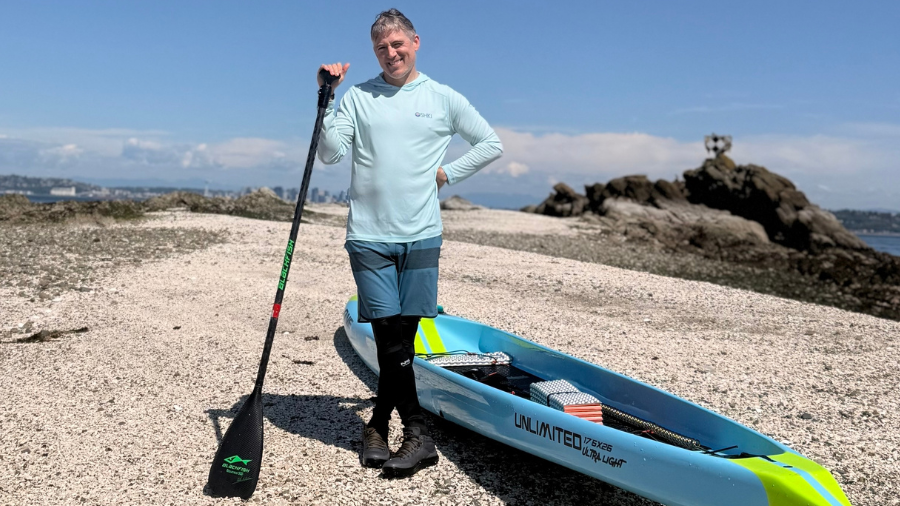
Eric Strickler returns to take on the legendary Race to Alaska (R2AK), a 750-mile ultra-endurance challenge from Washington State to Ketchikan. A wilderness medicine instructor, expedition leader, and ACA instructor based on Bainbridge Island, he once again steps into one of the most demanding expedition paddling events in the world.
In the lead-up to Eric Strickler’s Race to Alaska (R2AK) attempt, we caught up with him to dive deeper into his story, mindset, and the motivation behind taking on some of the world’s toughest endurance paddling challenges. From crossing Lake Michigan by SUP to joining Blackfish’s own Peter Allen as support crew for the Great Alabama 650 this October, Eric has built a life around adventure, exploration, and pushing the limits.
As Eric puts it, extreme SUP events “bring out the rawest and most authentic sides of people.” Here’s his authentic story.
Hi Eric! Could you tell us about your background in watersports and how you eventually found your way into endurance paddleboarding?
We also had a small farm along the New River in Virginia, where I’d swim, tube, and canoe on the river. In college, I was president of our sea kayaking club, and I had this idea to kayak across Lake Michigan. It didn’t happen - probably for the best - but from that point on (around 2007), I felt this real draw toward expeditions, especially those on big open water.
I started paddleboarding more in 2015 after a mountaineering accident shifted me away from that sport. Then in 2018, a friend asked if I wanted to SUP across Lake Michigan with him, and I was immediately all in. I ended up moving back home to Michigan from Washington state and started training seriously. We didn’t quite make it across that first year, but we successfully crossed Lake Michigan in 2019. Since then, I’ve mostly been looking for fun paddling challenges that keep me motivated, give me a reason to stay in shape, and take me to new places to explore.
What’s your story with Race to Alaska, and what are your expectations going into it this time? Why choose one of the toughest, most unpredictable endurance races on the planet - especially on a SUP?
I worked on the S/V Carlyn with Salish Sea Expeditions for six years before it was absorbed by the Northwest Maritime Center. A lot of the staff were stoked on the race, and it gradually became this lofty, epic challenge in my mind. As my nautical skills and knowledge grew, and I gained more experience paddling tidal waters around the Salish Sea, I kept seeking out fun and challenging places to paddle.
I chose SUP because I really don’t like sitting in a sea kayak — my back starts hurting, my butt itches, and I can’t see the birds, whales, and waves as well. I carry a little monocular for all those purposes.
I really love the wildlife and wild landscape aspect of training for these races. While I might be interested in other paddling craft in the future, right now I’m fully invested in SUP. I’ve got this beautiful backyard to train in, a kick-ass board, and I’ve maintained a fitness level where it actually feels reasonable to think I might be able to pull off the race on the least reasonable vessel possible.
Plus, my balance is going to be top notch by the time I’m done 😉
R2AK’s tagline is essentially “no engines, no support, all guts.” What does an ultra-endurance challenge like this reveal about a person once things start getting really hard?
Some version of: “There is more in us than we know. If we could be made to see it, perhaps for the rest of our lives we would be unwilling to settle for less.”
That quote is attributed to Kurt Hahn, the founder of Outward Bound. I did a few Outward Bound courses as a teenager when I was in need of direction, and ever since then I’ve found a lot of meaning and renewal in doing really hard things. It’s easy to get comfortable or lazy in day-to-day life.
But challenging experiences force you out of taking shortcuts because you simply don’t have another option. They rewire the part of the mind that says, “I’d rather not,” into one that realizes, “I can because I must.” I think that’s a powerful perspective to carry into everyday life when challenges or inconveniences inevitably show up.
Team Apple Bottom Boy - and your SUP “Swimmey”- are names people won’t forget. What’s the story behind them?
My first 7048 race was in 2020 or 2021… I honestly can’t remember now. Maybe blame it on Covid brain. At the time, I was living at our small family orchard in rural Virginia, down in an Appalachian holler.
So: apples, a river valley bottom, and then the song “Low” by Flo Rida popped into my head - “apple bottom jeans and the boots with the furrrrrrr” - and that’s how the team name I decided to keep was born. One year I entered 7048 as “Apple Bottom Boy and the Booties with the Fleece,” but the registration overlords shortened it.
I think “Swimmey” was a pretty spontaneous choice when the R2AK application asked me to name my vessel, though I definitely feel a close relationship with the little buddy now. Sorry it doesn’t have a better backstory. I do really love to swim.
Could you tell us more about your board and your Blackfish Paddles setup? What made that the right choice for a race as demanding as Race to Alaska?
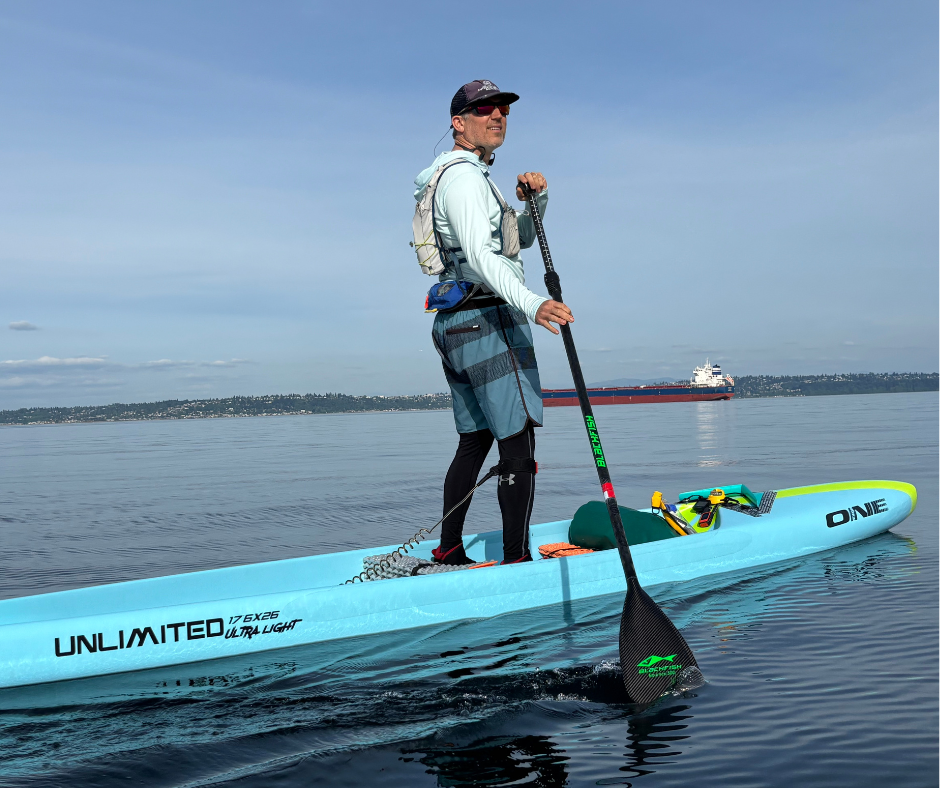
For the board setup, I knew I would need something 14+ feet because of the amount of gear I’d have to carry. I honestly didn’t know much about unlimited boards until I started digging deeper into specific boards for the race in spring 2025. I’d kept an eye on what other people were using, but after researching a few options and connecting with Peter up in Vancouver to demo the ONE-SUP board, I realized I really just needed to get something and begin the process of adapting to it - figuring out packing systems and how to manage the gear and conditions I’d face out there.
Peter had acquired a newer version of the board he used in his 2024 attempt - this one with a rudder - and he ended up selling me that one. I remember him saying I could custom order a board and ask for any modifications I wanted for the race, and I responded, “Whatever you’ve already done is probably the best insight I could hope for.” The dugout design is also great for the rough conditions I’ll experience and gives me a defined space where I can manage gear more easily.
Of course, Peter is also involved with Blackfish Paddles, so it made sense to check them out alongside the board purchase. I’ve never really raced in a competitive sense — mostly just against myself or within personal and group challenges - so I’d never invested in top-tier performance paddles. I’ve used three-piece paddles when traveling to teach SUP and fiberglass paddles for whitewater SUP on rivers, but the Blackfish paddles were by far the lightest, smoothest, and most natural-feeling paddles I’d ever used.
I’ve mainly been training with the Blackfish Noumea, and it’s been great as an endurance paddle. I also carry the Yukon as my backup onboard. I had this idea that after 500 or so miles maybe I’d become such a paddling beast that I could switch to the larger blade size of the Yukon and power my way faster toward the finish. That logic may be flawed.
I also love that both paddles are adjustable because I know I’ll probably spend a fair bit of time kneeling when conditions get rough. I feel like I’ve put together a pretty good kneeling setup to make that as comfortable as possible. It evolved through a lot of Walmart Z-Rest camping pads and a pair of kitchen shears, but now I’ve got a seating system that feels a lot like a comfortable whitewater canoe setup. It works really well with the paddles shortened all the way down for windy, wavy conditions where standing just isn’t realistic.
You’re also down for supporting Peter on his Great Alabama 650 attempt - what draws you into these ultra-endurance efforts, both as a competitor and as support?
They just capture the imagination. As long as I can remember, I’ve loved maps and thinking about the adventures that could come from trying to connect two points on one. These adventure races really stir that desire for exploration in me. While I love planning my own expeditions, it’s also nice to have an itinerary somewhat pre-made for you - and when that itinerary is incredibly challenging, it becomes even more rewarding to train for and compete in.
Having worked in a variety of outdoor guiding roles with teams both small and large, the experiences and co-workers I remember most came from some of the hardest - and most rewarding - situations I’ve been through. I think the community around these ultra events shares a pretty unique camaraderie, even when you’re meeting someone for the first time.
It’s also a pretty safe bet you’re going to meet people who don’t complain much, because they already understand that serious discomfort comes with even attempting these races.
I also think supporting these events is really special because you get to watch people push themselves to their absolute limits. They’re giving everything they have, and that’s both inspiring to witness and an incredibly vulnerable place for the racer to be. These events tend to bring out the rawest and most authentic sides of people.
If you had to capture ultra-endurance paddleboarding in just three words, what would they be?
Grit - wonder – discipline.
Thank you Eric - We can't wait to follow your journey! Have an epic one and stay safe!
Follow Eric's journey and find him on Instagram.
Sign up for the Blackfish Paddles newsletter to get exclusive updates and insider news